Startups Face Uphill Battle for Share of $151B Golden Dome Missile Defense Contract
July 29, 2025
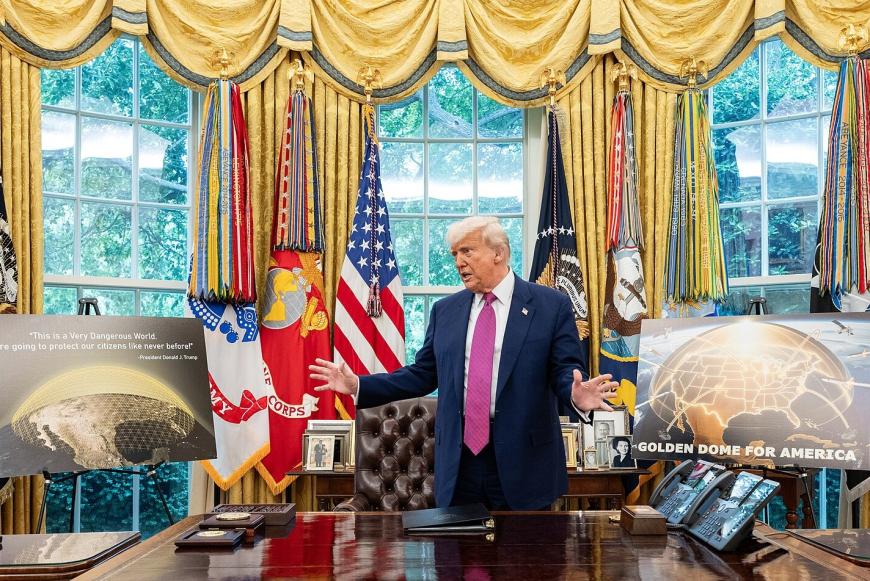 The U.S. government’s ambitious plan to build a next-generation missile defense system, dubbed Golden Dome, is shaping up to be one of the largest defense tech investments in recent history — with $151 billion up for grabs over a 10-year contract. But while the Pentagon has opened the door to competition, startups may find that door difficult to walk through.
Golden Dome, a Trump-era initiative modeled in part after Israel’s Iron Dome, will be developed under the newly announced SHIELD contract vehicle — short for Scalable Homeland Innovative Enterprise Layered Defense. The effort will span space-, land-, and sea-based missile defense technologies, from interceptors in orbit to sea-borne detection systems, in an attempt to build a unified shield for the continental United States.
But despite the opportunity, the contracting structure — which follows Federal Acquisition Regulation (FAR) rules and the Competition in Contracting Act (CICA) — places high regulatory burdens on would-be suppliers, especially smaller companies. The result is a battlefield where legacy defense giants like Lockheed Martin, RTX (formerly Raytheon), Boeing, and L3Harris maintain a dominant edge.
“Startups won’t be competing head-to-head as primes,” said Bryce Dabbs, CEO of defense consulting firm Approach Venture. “Their path in is through teaming and subcontracting.” He estimates that just 5% to 10% of the $151 billion could realistically go to non-traditional vendors — and even then, mostly through partnerships with large defense contractors.
While venture-backed companies like SpaceX and Anduril have the scale, security clearances, and cash flow to act as prime contractors, smaller startups often lack the infrastructure needed to meet classified work requirements, such as facility clearances, personnel vetting, and IT compliance.
“Many early-stage startups simply can’t meet the compliance burdens set by FAR,” Dabbs said. “Even if they have the tech, they don’t have the paperwork.”
The Missile Defense Agency (MDA) released a draft solicitation last week, beginning the process of qualifying vendors for the SHIELD vehicle. Getting on the vehicle doesn’t guarantee work — it only gives companies the ability to bid on future task orders under the umbrella program. Still, that hasn’t stopped firms from lobbying hard for position ahead of the final solicitation, expected later this year.
Meanwhile, larger firms are already jockeying for advantage. Lockheed Martin launched a dedicated “Golden Dome for America” page, and a coalition featuring SpaceX, Anduril, and Palantir has reportedly begun meeting with federal officials to pitch their readiness.
But not everyone is convinced the structure will deliver real innovation. William Greenwalt, former deputy undersecretary of defense industrial policy, criticized the government’s use of FAR and CICA to structure the SHIELD contract. “This is the dumbest way to do this if you want innovation,” he said, arguing instead for Other Transaction Authority (OTA) — a more flexible contracting approach that allows the Department of Defense to fund prototypes from non-traditional vendors with fewer barriers.
“FAR requires open competition in name, but in practice, it locks out the new players,” Greenwalt added. “This should be done as an OTA — plain and simple.”
Golden Dome’s tight timeline further tilts the field toward incumbents. The system’s final architecture is expected within three years, a pace that favors mature, deployable technology over R&D-stage experimentation. General Michael Guetlein, a top U.S. Space Force official tapped to lead the effort, has made it clear: “Golden Dome is a bold and aggressive approach to hurry up and protect the homeland.”
For now, investors are watching closely. Dabbs noted that more early-stage startup founders and VCs are referencing Golden Dome in pitch decks and due diligence calls, often without fully understanding the procurement complexities that lie ahead.
Still, with $151 billion on the line and rising urgency around homeland defense, the program represents a massive opportunity — and an equally massive test of whether the U.S. defense acquisition system can evolve to embrace innovation beyond the beltway.
|
|
|
Sign Up to
Our Newsletter!
Get the latest news in tech.
|
|
|
